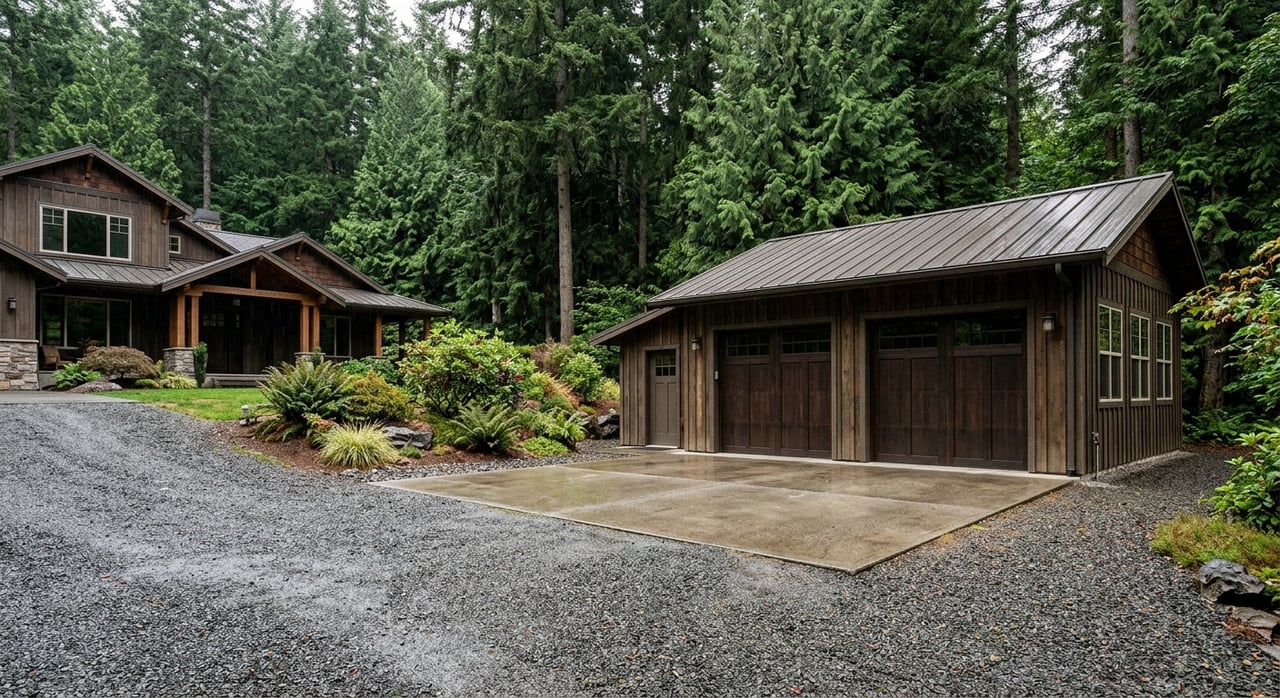
Acreage Living Near Battle Ground: Buyer Essentials
July 16, 2026
July 16, 2026
Dreaming about more space near Battle Ground? Acreage can offer room to spread out, build a shop, garden, or simply enjoy a quieter setting, but it also comes with a very different set of buying decisions than a typical neighborhood home. If you are thinking about buying acreage in Clark County, knowing how wells, septic systems, zoning, and permits work can help you avoid expensive surprises. Let’s dive in.
Battle Ground-area acreage is not one single property type. Local housing data shows this is largely a detached-home market, with Battle Ground city made up of 79% single-unit housing and the broader Battle Ground CCD at 81% single-unit housing. Owner occupancy is also high, at 73% in the city and 78% in the broader CCD.
That matters because your options may range from newer homes on larger lots to older rural properties with barns, shops, or other accessory buildings. You should expect variety in home age, layout, utility setup, and overall upkeep rather than a predictable, one-size-fits-all market.
Battle Ground has also grown significantly, from 9,296 residents in 2000 to 20,743 in 2020. Even with that growth, many nearby properties still fall under rural land rules that differ from what you may be used to in a standard subdivision.
In rural Clark County, the land itself often drives the decision as much as the house does. Clark County states that rural land designations are meant for residential living in rural areas, with farming and forestry allowed and encouraged as small-scale activities.
The county also notes that Rural 5, Rural 10, and Rural 20 designations generally correspond to one dwelling unit per 5, 10, or 20 acres. If you are picturing future projects, extra structures, or expanded use of the land, the parcel’s zoning can shape what is realistic.
This is one of the biggest differences between acreage buying and buying in town. A property may look perfect at first glance, but the zoning, site layout, and utility capacity may limit what you can actually do later.
Acreage near Battle Ground is not automatically a bargain just because it is outside a typical neighborhood. Census data shows a median owner-occupied home value of $485,100 in Battle Ground city and $600,200 in the broader Battle Ground CCD.
Those figures do not tell you what any specific acreage property is worth, but they do show that this market can carry meaningful value. On larger rural properties, your total cost picture may also include well testing, septic maintenance, permit work, and future site improvements.
That is why it helps to look beyond the list price. A lower-priced property with older systems or unclear records can become more expensive than a better-documented home with fewer unknowns.
For many acreage buyers, the first big question is water. Clark County says individual wells provide water to 24% of county residents, which means private wells are common enough that you should be ready to evaluate them carefully.
According to Clark County, new or replacement wells must be tested for coliform bacteria, arsenic, and nitrate. Washington State Department of Health also recommends that private well owners test for coliform bacteria and nitrate every year, and test for arsenic at least twice during ownership.
If you are buying a home with a private well, ask for the latest water test results early in the process. This is one of those details that can affect both your immediate comfort level and your long-term ownership costs.
Water questions are not only about drinking quality. Washington Ecology says water is not a property right in Washington, and a water right may be needed if use exceeds 5,000 gallons per day or irrigation exceeds one-half acre.
That becomes important if you hope to add pasture, irrigate a large garden, or support future outbuildings or other improvements. A property that seems ideal for a rural lifestyle may still have limits tied to water use, well planning, or approvals.
Clark County also notes that a WAVE, or water adequacy and verification evaluation, is often required before building permits are issued. If your goals include future construction, water adequacy can become part of the timeline.
If a property is not connected to public sewer, the septic system needs close review. Clark County says a current Report of System Status should be on file before a septic-served home is listed for sale, and that the report is current if it was completed within one year of the sale date.
That report is not just paperwork. It can help you understand whether the system is functioning properly, whether it has been maintained, and whether there are warning signs you should investigate further.
Inspection frequency also depends on the type of system. Clark County says simple gravity systems are typically inspected every 3 years, pressure distribution systems every 2 years, and alternative systems annually.
Before you get too attached to an acreage property, ask for the septic as-built, permit, and latest inspection history. Clark County says its Property Information Center can help confirm whether the septic system is properly documented and can provide access to as-built drawings, permits, and recent inspection records.
This step can save you from guessing about the age, size, and layout of the system. It can also help you understand whether the current setup supports how you plan to use the property.
Septic costs also matter in your budgeting. Clark County notes that replacement can run about $7,000 to $15,000, so septic should be treated as a serious ownership cost, not a minor maintenance item.
Acreage buyers often focus on what they want to add, whether that is a shop, garage, barn, deck, or fenced area. Clark County says a building permit is required to build a shop or garage in both urban and rural areas, including pole buildings.
Permit review may consider whether the lot was legally established, whether sensitive areas are present, and where drain fields, reserve drain fields, and easements are located. In other words, available land does not always mean buildable land.
Clark County also notes that decks generally need permits unless they are very small, low platform structures, while fences 7 feet or less do not need a permit. Even on acreage, it is smart to verify the rules before making assumptions about a future project.
If you are hoping for a second living space, be careful not to assume acreage gives you unlimited flexibility. Clark County says second residences and accessory dwelling units are not allowed in rural areas in the standard sense, though a rural accessory dwelling unit may be allowed in certain rural or resource zones if it meets code and receives the required permits and certificate of occupancy.
The county also states that a rural accessory dwelling unit generally cannot exceed 1,500 square feet in most cases. If your long-term plan includes multigenerational living, guest space, or rental use, this is a key detail to confirm before you buy.
This is where local guidance matters. The right property for you is not just the one with the most land, but the one that fits your actual plans on paper as well as in person.
Even if zoning seems promising, the site itself can still create challenges. Clark County says the soil and site evaluation process for septic-related construction looks at water, ditches, wells, utilities, forested areas, and slopes.
The county also says a current soil and site evaluation is valid for five years. That means an older evaluation may not give you the full picture if your project is still years away.
This is especially important on beautiful parcels with uneven terrain or tight building areas. A property can feel full of potential and still have limited room for new drain fields, reserve areas, setbacks, or future structures.
Acreage buying works best when you budget for the systems behind the lifestyle. Clark County guidance shows a basic septic operation and maintenance inspection may run about $99 to $115, while other county guidance notes septic inspections can range from $200 to $500 depending on system complexity.
There may also be permit-related costs along the way. Clark County’s environmental permit fee schedule lists a $230 site inspection fee for certain applications, and the county says application fees are doubled if onsite work begins before permits are issued.
That is an expensive way to learn that “do it now and sort it out later” is not a good rural property strategy. On acreage, patience and planning often save real money.
Before you move forward on an acreage property, keep this checklist in mind:
Acreage can be a great fit if you go in with clear expectations. The goal is not to avoid rural properties. It is to understand them well enough to buy with confidence.
With acreage homes near Battle Ground, the smartest buyers look past curb appeal and ask better questions early. If you want practical guidance on evaluating land, structures, and the real-world condition issues that can affect your decision, Dawn Jensen-Beaudoin can help you navigate the process with local insight and contractor-informed perspective.
Stay up to date on the latest real estate trends.
Let’s build your future in Southwest Washington. Contact me today for a strategy session that goes deeper than the floorboards.